
Why does mould appear at home in winter and when should you call a professional?
Translated from the original Spanish article.
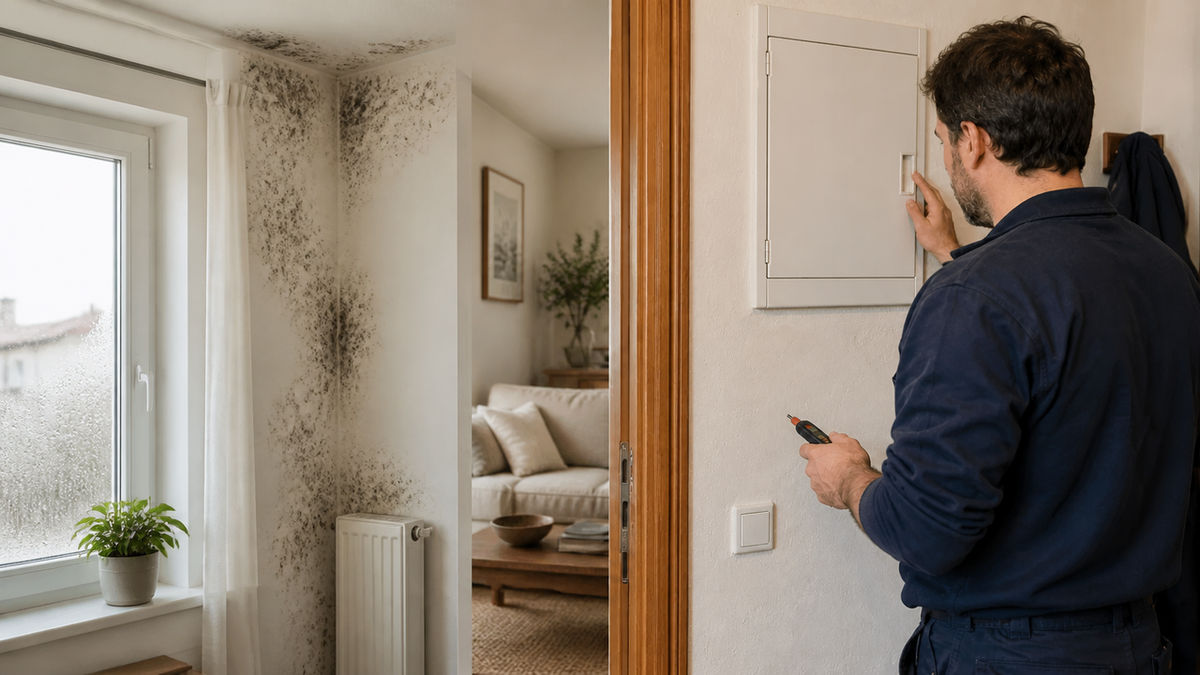
The short answer
Surface condensation occurs when the water vapour present in the air comes into contact with a cold surface whose temperature is below the dew point of the surrounding air. If ventilation is insufficient, water vapour builds up and condenses on cold surfaces, and an incorrect constructive solution in external enclosures creates thermal bridges or cold spots where vapour can condense. If ventilation is insufficient, vapour builds up and condenses, whereas if the insulation of an external enclosure is deficient a cold spot is created, so it is worth distinguishing which of the two situations applies.
Why does mould appear at home in winter?
When it cools, the vapour turns into liquid water that settles on the wall.
The first origin, and the most common, is inadequate use of heating and ventilation. Cooking, showering, drying clothes or simply breathing generate vapour; if ventilation is insufficient, that vapour accumulates and condenses on cold surfaces.
The second origin is an incorrect constructive solution in external enclosures. If the insulation is deficient, the temperature of the interior surface drops a lot, especially in cold climates, and a thermal bridge or cold spot forms where vapour condenses easily.
Mould appears at those cold spots and persists in corners, recesses and areas covered by curtains or furniture, where ventilation is harder. According to Fundación Musaat, direct condensation (100 % relative humidity) is not essential, and it is enough for relative humidity to reach 80 % for humidity problems to occur on the interior wall. According to Fundación Musaat, the limits of 40 % to 60 % relative humidity, based on health criteria, define the optimal zone, and above 60 % humidity is considered high, with mould growth and condensation. According to Fundación Musaat, surface mould appears when relative humidity reaches 80 % at the surface, even if there is no direct condensation.
How do I tell condensation mould apart from damp caused by seepage or capillary rise?
The three most frequent types of damp in homes are condensation, capillary rise and seepage, and each leaves a different stain. Condensation appears as brownish fungal colonies at the coldest points of the enclosures.
Capillary rise produces a uniform stain showing water rising from the base to a constant height, and it is more common on ground floors. With seepage, the stain spreads from the point of origin towards its edges.
Guidelines on the appearance of the stain indicate where the moisture comes from, but they do not replace an inspection of the specific case.
How to recognise each type of damp by its stain
| Type of damp | How it appears on the wall |
|---|---|
| Condensation | Brownish fungal colonies at the coldest points of the enclosures |
| Capillary rise | Uniform stain showing water rising from the base to a constant height; more common on ground floors |
| Seepage | The stain spreads from the seepage point of origin towards its edges |
When is it worth calling a professional?
It is worth distinguishing whether the origin lies in insufficient ventilation or in an incorrect constructive solution, such as deficient insulation in an external enclosure. If the stain starts from a point and spreads outwards, you need to locate where the water enters, for example a leak. If it rises uniformly from the base to a constant height, the problem is capillary rise.
If the insulation of an external enclosure is deficient, the temperature of the interior surface drops and a cold spot forms where water vapour can easily condense, which points to an incorrect constructive solution. It is also a warning sign if the damp persists and starts to damage paint, plaster or wood, with flaking, stains or rot.
If the mould is superficial and appears in poorly ventilated spots with a lot of vapour, adjusting ventilation and heating use is the first step. We help you find the right professional for your home, community or business, and you do not need to know how it is fixed: just tell us what is happening. If the insulation of an external enclosure is deficient, the temperature of the interior surface can drop a lot and create a thermal bridge or cold spot where water vapour from the indoor air condenses easily.
What health risks does mould pose at home?
The WHO's scientific review on indoor damp and mould concludes that the most important effects are a higher prevalence of respiratory symptoms, allergies and asthma, as well as alterations to the immune system.
Mould can release spores that cause respiratory problems, allergies and other conditions, and the presence of mould and damp can produce a damp or stuffy smell in the environment.
According to the WHO, the most important measure to avoid these effects is to prevent, or minimise, persistent moisture and microbial growth on interior surfaces and in the building structure.
Sources
- Diagnóstico de patologías por condensación: Identificación y elaboración del informe técnico, Fundación Musaat, noviembre 2025
- WHO guidelines for indoor air quality : dampness and mould, WHO/EURO, 1 January 2009