
Plumbing in a full renovation: what to check before closing walls
Translated from the original Spanish article.
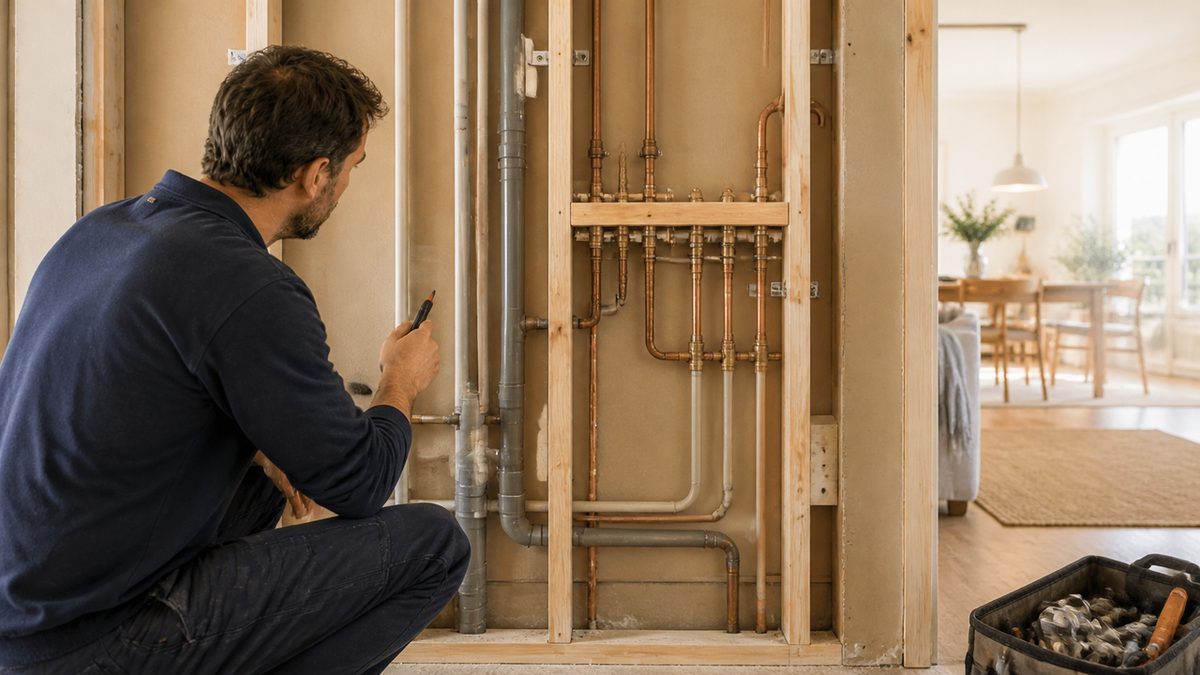
The short answer
Before closing walls, require that the water installation has the service checks and tests provided for in the project or technical report, or those ordered by the qualified installer or the installation director where their participation is mandatory, in addition to those required by current regulations. These tests should be those provided for in the project or technical report, those ordered by the qualified installer or the installation director where their participation is mandatory, those of Technical Instruction 2, and those required by current regulations. It is advisable to request them section by section while the pipes are still accessible.
What plumbing tests to require before closing the walls
The tests of the finished installation must be carried out on the whole or on its parts, and the thermal installations regulation requires that the checks provided for in the project, in the technical report, or those ordered by the qualified installer or the installation director be performed. For water networks, before the tightness test and the final filling, the pipes must be cleaned internally to remove assembly residues.
The tightness test requires closing open terminals. Before carrying it out, check that the appliances and fittings in the section withstand the pressure to which they will be subjected; if they do not, they must be excluded by closing valves or replacing them with plugs. In water networks for sanitary uses, the use of detergent products is not permitted.
The tests are carried out by the installing company, which must have the human and material resources necessary to perform partial and final tests. The qualified installer or the installation director, where their participation is mandatory, must give their approval both to the procedure followed and to the results obtained. The Technical Building Code provides that service checks and tests be carried out on the finished works, either on the building as a whole or on its different parts and installations, partially or fully completed.
The service checks and tests of the finished installation are those provided for in the project or technical report, those ordered by the qualified installer or the installation director, and those required by current regulations, and this article does not set specific values for test pressure, gradients, diameters or materials. Any renovation of an installation covered by article 2.3 of the RITE requires a prior project or technical report, so it is advisable to confirm with the installer whether your installation falls within that scope before treating these tests as applicable.
Water network checks before closing walls
| Check | What the regulation requires | How to verify it |
|---|---|---|
| Planned tests | Carry out the service checks and tests provided for in the project or technical report, those of IT 2 and those required by current regulations | Compare the tests performed with those provided for in the project or technical report or those ordered by the qualified installer |
| Internal cleaning of pipes | Clean water networks internally to remove assembly residues before the tightness test and the final filling | Check that no detergents have been used in water networks for sanitary uses |
| Preparation for the tightness test | Close open terminals and check that appliances and fittings in the section withstand the test pressure | Verify that appliances that do not withstand it are excluded by closing valves or replaced with plugs |
| Who carries out and who validates the tests | The tests are carried out by the installing company with the means needed for partial and final tests | That they are performed in the presence of the qualified installer or the installation director, who gives approval to the procedure and the results |
| Tests on parts already completed | Service tests may be carried out on installations partially or fully completed, in addition to voluntary ones | Confirm that the tests provided for in the project or those ordered by the technical management are carried out |
What regulations apply to plumbing in a renovation
The Technical Building Code also applies to interventions in existing buildings, and its compliance must be justified in a project or in a report signed by a competent technician, together with the application for the licence or authorisation of the works. If the prior licence is replaced by a responsible declaration or prior notification, it must be expressly stated that this project or report is available.
On water matters, the Code requires means to supply water fit for consumption with sufficient flow rates, without altering its properties and preventing backflows that could contaminate the network. It also requires adequate means to remove wastewater.
The thermal installations regulation requires that any renovation of the installations it covers require a prior project or technical report justifying compliance with its requirements in the renovated part. The autonomous communities may add requirements in their territory, so it is advisable to confirm with the installer what applies in your area.
What documentation the installer must give you
Once the installation has been registered by the competent body of the autonomous community, the qualified installer or the installation director must give you the documentation to be incorporated into the Building Logbook. This documentation comprises the project or technical report of the installation as actually executed, the operation and maintenance manual, and the list of materials and equipment actually installed, with their technical and operating characteristics and their origin documentation and warranty.
The delivery must also include the results of the commissioning tests, the installation certificate registered with the autonomous community and, where mandatory, the initial inspection certificate.
As regards supplies, the documentation must include at a minimum the origin documents, the supply sheet and labelling, a copy of the manufacturer's warranty certificate, and the conformity documents, including the CE marking. Having the certificate registered does not imply technical approval or a favourable ruling on the suitability of the installation, and non-compliance with the regulations may lead to corrections or even the shutdown of the installation. This delivery of documentation applies to installations subject to the thermal installations regulation, so it must be confirmed whether the water installation in your renovation falls within its scope.
Sources
- BOE-A-2007-15820 Real Decreto 1027/2007, de 20 de julio, por el que se aprueba el Reglamento de Instalaciones Térmicas en los Edificios., Boletín Oficial del Estado, 20 July 2007
- Real Decreto 314/2006, de 17 de marzo, por el que se aprueba el Código Técnico de la Edificación., Ministerio de Vivienda, 17/03/2006
- RITE - Reglamento de instalaciones térmicas en los edificios, Ministerio para la Transición Ecológica y el Reto Demográfico, accessed 3 November 2026